Better Together: How Shared Workshop Spaces Are Changing the Game for Vintage RC Restorers
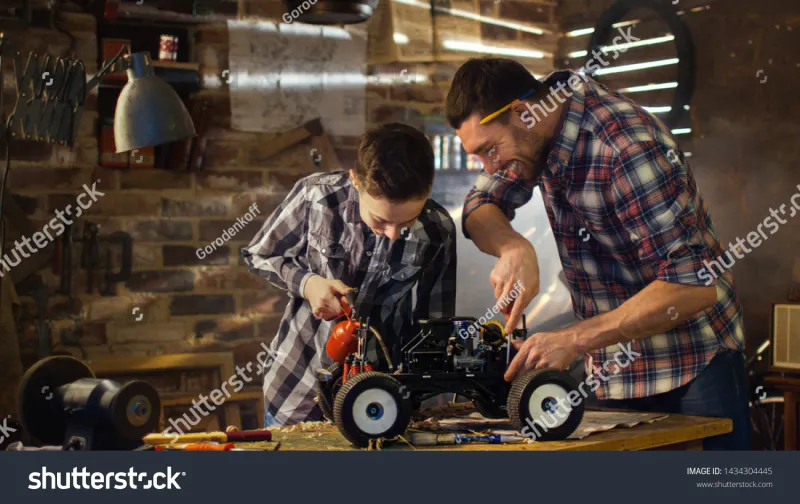
Photo: group of people working together in a garage workshop with RC cars on workbench, via image.shutterstock.com
There's a particular kind of frustration that every solo vintage RC restorer knows intimately. You've finally tracked down a beat-up but salvageable '80s-era Associated RC10, you've cleared off the workbench, you've got the coffee going—and then you hit a wall. Maybe it's a seized bearing you can't press out without the right tool. Maybe it's a hairline crack in a vintage Lexan body that needs a heat gun and a second set of hands. Maybe you just genuinely don't know whether that mystery motor is worth rewinding or should go straight into the parts bin.
Working alone is fine for the easy stuff. But vintage RC restoration is rarely easy stuff.
That's the quiet problem a lot of serious hobbyists in this community are bumping into, and it's pushing more and more of them toward something that's been hiding in plain sight: the shared workshop space.
The Solo Restorer's Ceiling
Let's be honest about what working out of your garage or spare bedroom actually looks like after a while. You accumulate a decent set of basic tools. You get pretty good at improvising. You develop workarounds for the specialized equipment you don't own—the bearing press, the soldering station with proper fume extraction, the decent spray booth for bodywork, the dyno setup for dialing in motors.
But improvising has limits, especially when you're dealing with cars that are 30 or 40 years old. Vintage RC components don't forgive sloppy technique the way modern injection-molded parts sometimes can. A plastic tub that's already brittle from age doesn't get a second chance if your makeshift pressing solution slips. The same goes for electrical work on vintage speed controllers, or trying to true a flywheel without a proper rotary tool setup.
Beyond the tooling problem, there's the knowledge gap. Unless you've been in this hobby for decades and specifically worked on the cars you're restoring, you're going to hit questions that YouTube can't fully answer. Sometimes you just need someone in the room who's rebuilt that exact gearbox before.
What a Community Workshop Actually Looks Like
The term "community workshop" covers a lot of ground, so it's worth breaking down the real-world versions that vintage RC folks are actually using.
Maker spaces are probably the most established option in most US cities. Places like TechShop (before its closure), local Fab Labs affiliated with universities, and independent community workshops in cities like Austin, Denver, Portland, and Raleigh often have surprisingly relevant equipment—laser cutters for fabricating replacement parts, metal lathes, proper soldering stations, and more. Some have started actively courting the RC crowd because the hobby generates consistent membership and the projects are genuinely interesting to the broader maker community.
Garage collectives are less formal but often more focused. These are typically a small group of hobbyists—anywhere from four to a dozen people—who pool money to rent a shared garage space or convert one member's large workshop into a communal setup. The gear gets shared, the costs get split, and the knowledge base multiplies. In places like suburban Ohio, the Carolinas, and Southern California's Inland Empire, these informal setups have quietly become the backbone of local vintage RC scenes.
Club-affiliated workshop nights represent a middle ground. A number of RC clubs that have been around since the vintage era—some with roots going back to the early Tamiya and Kyosho boom of the '80s—have evolved to include dedicated build and restoration nights separate from their race days. Members bring projects, tools get shared, and the older heads in the group pass on knowledge that genuinely can't be Googled.
The Real Benefits Go Beyond the Tool Rack
Here's what surprises most people when they first plug into a shared workshop environment: the tools are almost a secondary benefit.
The primary thing you gain is accountability. When you're working on a project in a community space, you show up. You make progress. There's a social contract at work that your home garage simply doesn't enforce. Plenty of vintage RC builds that spent two years sitting half-finished on a solo workbench have been completed in a matter of months once their owner started showing up to a weekly workshop night.
The second thing you gain is parts intelligence. In any group of serious vintage RC restorers, someone has a donor car. Someone has a bag of old hardware that matches exactly what you need. Someone bought a lot of 20 cars from an estate sale and has duplicates of everything. The informal parts economy that develops inside a good community workshop is worth real money over time.
And then there's the test space question, which doesn't get talked about enough. Where do you actually run your vintage RC car once it's built? In a lot of suburban and urban areas, finding a safe, legal, appropriate surface to test a freshly restored car is genuinely difficult. Community workshop groups tend to solve this organically—they find a parking lot, they connect with a school or church that'll let them use a gym or blacktop on weekends, they establish a regular spot. That infrastructure is hard to build alone.
How to Start Your Own Pit Crew Space
If your area doesn't have anything like this yet, the barrier to starting something is lower than you'd think. Here's a practical framework:
Start with four to six committed people. You don't need a crowd. You need a small group of people who are serious enough to show up consistently and contribute both tools and expertise. Post in your local Facebook RC groups, hit up the r/rccars subreddit with a geographic tag, or just talk to people at your nearest hobby shop.
Inventory what you collectively own before you spend a dime. You'll often find that your group already has most of the core tools covered across different members' garages. A shared Google Sheet works fine for this. Figure out what the actual gaps are before you start pooling money.
Find a space that fits your actual needs. A two-car garage is often enough to start. If no one in the group has that kind of space available, look at local maker spaces that offer after-hours rental, storage units with power access (more common than you'd think), or community centers with workshop facilities. Monthly costs in the $100–$300 range split four ways are genuinely manageable.
Set simple ground rules early. Who's responsible for keeping the space clean? How do shared consumables (solder, sandpaper, paint, etc.) get replenished? What happens if someone damages a shared tool? These conversations are boring but they're the difference between a workshop that runs for years and one that collapses after six months over a broken drill press.
Build a test track, even a small one. Even a basic 20x30 foot oval laid out in tape on a smooth floor gives you something to actually run finished cars on. That immediate payoff—hearing a freshly restored vintage machine actually rip around a track—is what keeps people showing up week after week.
The Hobby Is Better When It's Shared
Vintage RC restoration is a deeply personal hobby. The cars mean something. The history matters. The individual craftsmanship is real. None of that changes when you work in a community space—if anything, it gets amplified, because you're surrounded by people who get it at the same level you do.
The lone restorer in the garage has a certain romance to it, sure. But the pit crew model is just better. More gets built. More gets learned. More gets preserved. And honestly? It's a lot more fun.
If you're already part of a community workshop setup, drop your experience in the comments—we'd love to hear what's working. And if you're thinking about starting something, reach out. The vintage RC community is smaller than the mainstream hobby world, but it's tighter for exactly that reason.